What Is Business Architecture? Definition, Benefits & FAQ

Today, there is much confusion surrounding Business Architecture (BA): The field appears so irregular because academia, publications, consultants, AI, and the Internet, present BA in disparate voices advancing a multitude of approaches, meanings, and sets of expectations—some based on internet writings, some based on conjecture, and some based on opinion, and yes, some based on sound practices. It has become more difficult than ever to separate BA facts from beliefs, experiences from opinions, and sound practices from declarations.

There are various methodologies, frameworks, and certifications. Depending on the complexity and scale of the organizations, people can select from commercial, defense industry, government "frameworks" and "methodologies." We suggest your time will be well spent comparing BA results, deliverables, frameworks, methodologies, certifications, and more.

Article Summary: This article answers frequently asked questions about BA based on nature and physics, sound practices, and principles based on over 4,500 of field engagements and five decades of Realistic, Enabling, Actionable, Logical (R.E.A.L) BA Results.

The article begins with describing the business architecture meaning, answering “What is a Business Architecture” based on the BACOE™ fully integrated vendor neutral practitioner based Methodology. We then provide:
The Business Architecture Center Of Excellence (BACOE)’s

Practitioner-Based Business Architecture Definition

We begin by first defining “architecture” and then “Business.” Then we define Business Architecture.

“Architecture” is the art and science of organizing, structuring, and integrating components into a cohesive whole. It serves as the foundation for managing complexity, enabling change, and designing effective solutions.

Within BA, “Business” refers to any defined boundary of roles and responsibilities aligned to a common objective or outcome. This can include:

  • Entire enterprises or corporations

  • Business units or divisions

  • Government agencies

  • Departments or teams

  • Multi-organization ecosystems

  • Projects or initiatives

In essence, “business” is a boundary condition defined by shared goals.

Business Architecture Defined

Business Architecture (BA) is the explicit representation of an organization’s future state (desired) and current state (as is), using a set of independent, non-redundant artifacts. These artifacts define relationships across the enterprise and enable the development of prioritized, aligned business capabilities required to achieve organizational goals. Business Architecture communicates this understanding to stakeholders and guides the transformation from the current state to the desired state.*


Summary of BACOE Business Architecture:

  • In the context of your projects, departments, or organizations, BACOE Business Architecture uses human-consumable stakeholder-focused deliverables and outcome-driven roadmaps to drive projects, departments, or organizations strategies to specific desired outcomes.

  • The BACOE Quick Start methodology to business Architecture demystifies the process of designing the architecture of the business. It provides a step-by-step approach to Business Architecture, ensuring the organization meets the business goals and business objectives established by management.

  • By following this methodology, organizations can systematically develop their business capabilities in alignment with their strategic objectives. The BACOE approach ensures a holistic view of the organization, facilitating more effective capability development and, ultimately, better strategic execution.

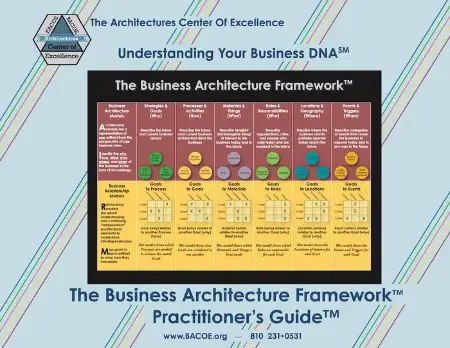
Business Architecture Practitioner Guide (BACOE)

What are the differences between Enterprise Architecture and Business Architecture?


Summary: Business Architecture is often incorrectly positioned as a subset of Enterprise Architecture or reduced to business process architecture modeling. In reality, it is a distinct, business-driven discipline focused on defining what the business is and how it operates - independent of implementation.

Business Architects focus on:

  • Defining a shared future-state vision

  • Identifying and prioritizing business capabilities

  • Enabling continuous organizational transformation


  • While Enterprise Architects may produce technology perspectives, Business Architecture remains business-first and technology-neutral.

  • Enterprise Architecture is the shared integrated view of what needs to be common across the enterprise – an “inch deep and a mile wide”. 

  • Business Architecture is a “mile deep and an inch wide”. 

  • Enterprise Architecture defines the initiatives to enable enterprise goals. 

  • Business Architecture develops and defines the capabilities required to achieve goals.

A physical example may be in order:

no one would say that the plumbing drawing in a house is part of the electrical drawing or the electrical drawing is part of the heating ventilation and air conditioning drawing all of these are different perspectives and views of the house in and of itself this is the same thing that's true about the enterprise understanding of which enterprise architecture and business architecture are two of the twelve architectures in an enterprise.


Frequently Asked Questions (FAQ) about Business Architecture

Answers to these questions are shown using the drop-down arrow next to each question.


How To Evaluate Business Architecture Development Approaches

Summary: Business Architecture methodology selection is a serious step that should be taken based on quantitative evaluation rather than influence of clever sales tactics or non-vetted reviews. A Business Architecture methodology is not easily exchanged if it does not meet expectations. Developing and implementing business architecture represents a long-term commitment that requires investment in education, training, certification, and practice, and a change in culture.

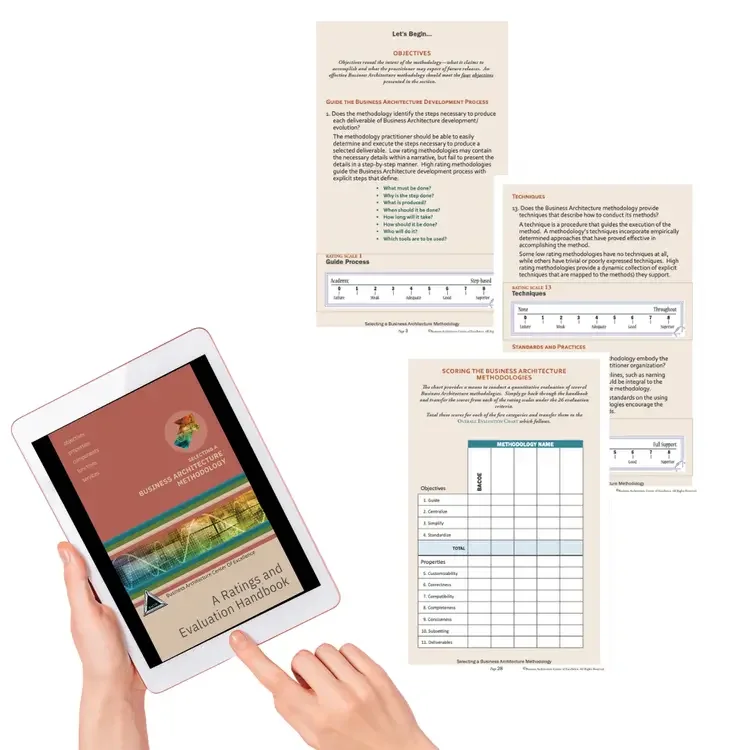
  • Use our handbook designed to help you evaluate a Business Architecture Methodology on a quantitative basis. Twenty six distinct criteria are divided into five categories—objectives, properties, components, functions, and services. Evaluating and comparing methodologies in this way can help your organization make a quality selection.

Evaluating Business Architecture Methodologies Handbooks


The Types of Business Architecture Agencies

If you are an individual or organization desirous of developing Business Architectures, there are various "self-described" Business Architecture frameworks, methodologies, certifications, tool, deliverables, and results.

There are primarily two types of organizations that provide Business Architecture frameworks, methodologies, and training;

Franchised-Based Business Architecture Agencies

  • Franchised-Based Organizations offer Business Architecture Certifications courses and training materials “for lease” and are offered similar to a hamburger-franchise model – the franchised teaching organization pays the course provider a fee, gets the course material, and then has the attendee come back to the franchiser and pays to take a multiple choice exam.

Practitioner-Based Business Architecture Agencies

  • Practitioner-Based Business Architecture Certification from BACOE teaches the attendee to actually do Business Architecture in the classroom, throough actual demonstrated practice, and is continually mentored by world-class Business Architects. Practitioner-Based is not a franchisee-friendly approach and is much more beneficial and rigorous. The practitioner-skilled instructors are World Class Business Architecture Practitioners, active in the Business Architecture field, not just script or PowerPoint slide readers.


Why is Business Architecture Important


Summary: Business Architecture serves as an essential guide for executives, business leaders, and consultants seeking to elevate their organization’s capabilities and competitive advantages in today’s dynamic business environment.

  • It provides a clear roadmap for translating strategic vision into tangible operational improvements. Business capabilities play a vital role in enabling strategic goals by providing the foundational elements needed to execute strategic plans. By focusing on developing and aligning the right capabilities, organizations can more effectively bridge the gap between strategic intent and operational execution, ultimately driving better business outcomes.


In today’s environment of increasing demand, complexity, and change, Business Architecture is no longer optional - it is foundational.

Organizations must answer:

  • How do we manage exponential increases in complexity?

  • How do we align strategy with execution effectively?

  • How do we enable continuous transformation?

Business Architecture provides the baseline for answering these questions - through explicit, structured, and actionable representations of the business.

The BACOE approach delivers a comprehensive, vendor-neutral, and proven framework for enabling strategy, optimizing operations, and driving measurable business results.

Business Architecture bridges the gap between strategy and execution. It aligns business intent with operational capabilities, ensuring organizations can adapt, scale, and compete effectively.

Core outcomes of Business Architecture include:

  • Strategic alignment between business goals and initiatives

  • Capability-based planning and prioritization

  • Improved decision-making through shared understanding

  • Structured transformation from vision to execution

For example, instead of launching disconnected transformation projects, a Business Architecture approach ensures all initiatives are aligned to clearly defined business capabilities - such as on-boarding of customers, delivery of products, or complying with regulations, - resulting in measurable business outcomes.


What Are the Benefits of Business Architecture (BACOE)

BACOE Business Architecture Methodology Solution Benefits and Advantages

Summary: The overarching benefit of the BACOE Business Architecture Methodology, Tools, Certification, and Business Architecture Framework™ is developing and representing the business capabilities required to achieve the business mission, goals, and objectives, providing a comprehensive frame of reference to align an organization's capabilities with its business strategy, enabling more informed decision-making, increased efficiency, and better adaptability to change.


BACOE uses three overarching categories of benefits for the BACOE Business Architecture approach, which can provide a measurable Return on Investment (ROI), or related measures. Of course, these categories of benefits are dependent upon the definition of Business Architecture – we use the Business Architecture Center Of Excellence (BACOE) definition.

Service Benefits

  • Improved customer and stakeholder experience

  • Greater business agility and responsiveness

  • Consistent and predictable service delivery

Financial Benefits

  • Reduced costs through standardization and reuse

  • Increased revenue through improved capability alignment

  • Measurable return on investment (ROI)

Infrastructure Benefits

  • Reduction of redundancy and inefficiencies

  • Simplified operations and optimized resource utilization

  • Lower transaction and operational costs

An endless stream of temporary advantages must replace sustainable advantage as the means to winning. This comes from the BACOE approach to Business Architecture, and is measurable.


Numerous additional benefits from the BACOE approach to Business Architecture include:

  • Providing Human “Consumable” Results requiring less than ninety seconds of instruction to understand any specific BACOE Deliverable.

  • Explicitly presenting a shared organizational vision.

  • Facilitating transparency in decision making.

  • Transitions from textual behemoth miscommunications and understandings, to graphical representations that are concise, unambiguous, easy to access, and simple to understand.

  • Providing a universal communication language for business to business staff communication, and business to technologist communication.

  • Focusing on business capabilities without carrying technical baggage.

  • Making key stakeholders active participants in developing and meeting business goals.

  • Providing the ability to describe project or undertakings in non-technological terms.

  • Providing technology neutrality rather than technology lock-in.

  • Developing a functional vocabulary.

  • Reaching across organizational boundaries.

  • Providing full traceability of all actions – models, definitions, sources, changes, stakeholders – etc.

  • Providing the choice of optimizing the entire organization or a business unit. The Methodology is repeatable no matter the size or type of “organization”.

  • Reducing misunderstandings between the business and information technology personnel, as they now have the same terms of reference. Business people and information technology people build from this same frame of reference.

  • Facilitating Cost reduction (standardization and reuse)

  • Providing True Business Agility (persistent and standardized models)

  • Facilitating Business Flexibility

  • Providing Reconfigure Resources

  • Speeding Knowledge Access

  • Facilitating Professionalism of Staff

  • De-coupling Knowledge from Individuals – Providing a True Knowledge Base (cope with volatility of staff)

  • Providing a Governance mechanism for Critical Assets

  • Establishing a Context for Architecture Education and Assessment

  • Creating an Adaptive Mechanism to Promote Alignment Between IT Assets and Business Capabilities

  • Facilitating Complexity Management

  • Enabling Managing Change

  • Providing a Mechanism for Determining Outsourcing Options

  • Allowing for the Continuous Exploiting of Intellectual Capital

  • Enabling Governance

  • Supporting Organizational Change

  • Identifying Cost Reduction Opportunities

  • Facilitating Developing Strategic Capabilities

  • Redesigning the Business Models


 BACOE Business Architecture Example Case Studies (Overview)

Having developed, implemented, managed, and “done” more successful “Business Architectures” than any other Firm - worldwide, The Business Architecture Center Of Excellence (BACOE) has thousands of successful Business Architecture engagements.

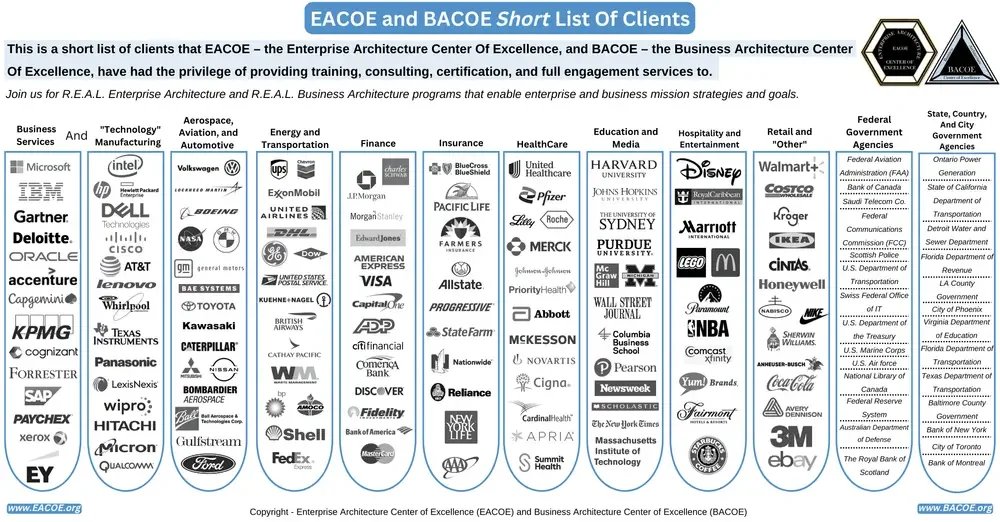
This is a short list of clients that have engaged BACOE – the Business Architecture Center Of Excellence, for training, consulting, certification, and full engagement services:

BACOE Business Architecture Short List of Clients

From BA 1.0 to BA 5.0

Evolution and History of Business Architecture

Summary: While much of the market still treats Business Architecture as either a lightly rebranded process mapping exercise or a subordinate stream within IT‑centric EA, the Business Architecture Center Of Excellence (BACOE) has developed a practitioner‑standard, business‑first discipline designed explicitly to define and direct what the business is and does.

 
  • BA 1.0 – Functional Process Mapping: Business as departments and procedures; documentation created mainly for local optimization and compliance.

  • BA 2.0 – Project‑Centric Business Analysis: Business requirements captured for projects; Business Architecture conflated with “better requirements.”

  • BA 3.0 – Information‑Aware Business Architecture: Recognition that business structures, information, and value streams must be modeled, but often as static, framework‑driven artifacts.

  • BA 4.0 – Continuous, Outcome‑Driven Business Architecture: BACOE‑style practice using the Business Architecture Framework™, Business Architecture Life Cycle, and outcome‑oriented planning to support ongoing change.

  • BA 5.0 – Strategy‑Enabling Business Architecture (BACOE Business Architecture 5.0): A practitioner‑based, business‑focused discipline that moves from projects to enterprise‑level change, from models to management, and from governance rhetoric to guidance, using human‑consumable frameworks, life cycles, and methods to directly enable business strategy.


For organizations seeking to modernize Business Architecture, the imperative is to stop treating BA as a project adjunct or documentation exercise, and to build a continuous, framework‑anchored, outcome‑oriented capability that can evolve into BA 5.0. In doing so, Business Architecture can fulfill its role as the discipline that helps designs, directs, and continuously refines the business itself.


Business Architecture Best Practices and Business Architecture Strategy

Business Architecture: The Enabler of Business Strategy

The Business Architecture Center Of Excellence (BACOE)’s Business Architecture is a leading enabler of business and mission strategy. This methodology provides a step-by-step guide to building Business Architectures that enable business and mission strategies.

Refined Process: The Business Architecture process presented is both theoretically sound and refined through actual practice. The methodologies have been tested and proven in real business environments.

Comprehensive Guide: It provides a thorough treatment of Business Architecture, covering topics from establishing and maturing a Business Architecture practice to actually developing a human-consumable Business Architecture.

Business-Centric Approach: BACOE emphasizes that Business Architecture helps the business run better, rather than "architecture for architecture's sake." This aligns well with the needs of business professionals looking to improve their organizations. This methodology helps organizations move from strategic intent to a business strategy to strategy enablement.

Strategy Execution Focus: The methodology emphasizes the role of Business Architecture in strategy execution, which may be particularly relevant for those interested in aligning business strategy with technology enablement.

Business Architecture: The Enabler of Business Strategy by Sam Holcman

References and Citations:

Author: Sam Holcman and ©Business Architecture Center Of Excellence™ (BACOE™) Team.

Author biography (overview): For over five decades, Sam Holcman has been considered the practitioner’s practitioner in Business Architecture, and the world’s leading implementer, educator, and trainer in Business Architecture methodologies and techniques. As the Managing Director of the Business Architecture Center Of Excellence (BACOE) since 1972, he has over 4,500 field engagements with organizations globally, in addition to coaching and certifying over 160,000 professionals in the discipline of BACOE™ Business Architecture.

Originally Published: January 8, 2019 | Last Updated: May 21, 2026